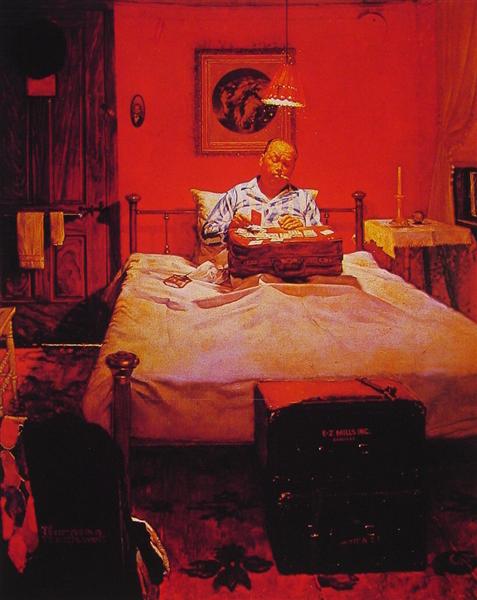
Given the decor of the room (red wallpaper or lighting, brass-framed double bed, floral carpet, pom pom fringe on the curtains) — anyone else think there’s a subtext here that this hotel used to be a brothel years ago but now it just puts up business travelers for the night and they have to provide their own entertainment?
I like this image. It was apparently a 1950 Saturday Evening Post cover and is often known as "Solitaire." If you could see out the window to the right, the sign saying "Room" is cut off by the window frame, so that it looks like it says "Doom." This may further reinforce the ex-brothel hypothesis. (The candle, I thin,, is probably for walking to the bathroom, which I'm sure was down the hall.) https://prints.nrm.org/detail/261009/rockwell-solitaire
Both paintings show solitary, lonely mid-century American figures in hotel rooms at night. But Rockwell's central figure is male, and apparently a traveling salesman, while Hopper's is a wealthy woman; Rockwell's room is cheap and old fashioned, Hopper's, elegant and modern; Rockwell imbues his image (despite the "Doom") with characteristic humor, while Hopper's feels characteristically existential; most interestingly, Rockwell tints everything in the room red, except the central figure, while Hopper confines red, a color I don't think he used often, to the central figure. I wonder (and this is of course pure speculation) if Hopper had Rockwell's image in the back of his mind?
![[personal profile]](https://www.dreamwidth.org/img/silk/identity/user.png) chiming
chiming


no subject
Date: 2019-03-29 07:52 pm (UTC)From:no subject
Date: 2019-03-29 09:28 pm (UTC)From:no subject
Date: 2019-03-31 09:16 pm (UTC)From:https://prints.nrm.org/detail/261009/rockwell-solitaire
I poked around and found the Edward Hopper painting, "Hotel Window" (1955). That painting and this one make an interesting contrast. https://www.edwardhopper.net/hotel-window.jsp
Both paintings show solitary, lonely mid-century American figures in hotel rooms at night. But Rockwell's central figure is male, and apparently a traveling salesman, while Hopper's is a wealthy woman; Rockwell's room is cheap and old fashioned, Hopper's, elegant and modern; Rockwell imbues his image (despite the "Doom") with characteristic humor, while Hopper's feels characteristically existential; most interestingly, Rockwell tints everything in the room red, except the central figure, while Hopper confines red, a color I don't think he used often, to the central figure. I wonder (and this is of course pure speculation) if Hopper had Rockwell's image in the back of his mind?